The Difference Between Studying for School Tests and Studying for Board Exams
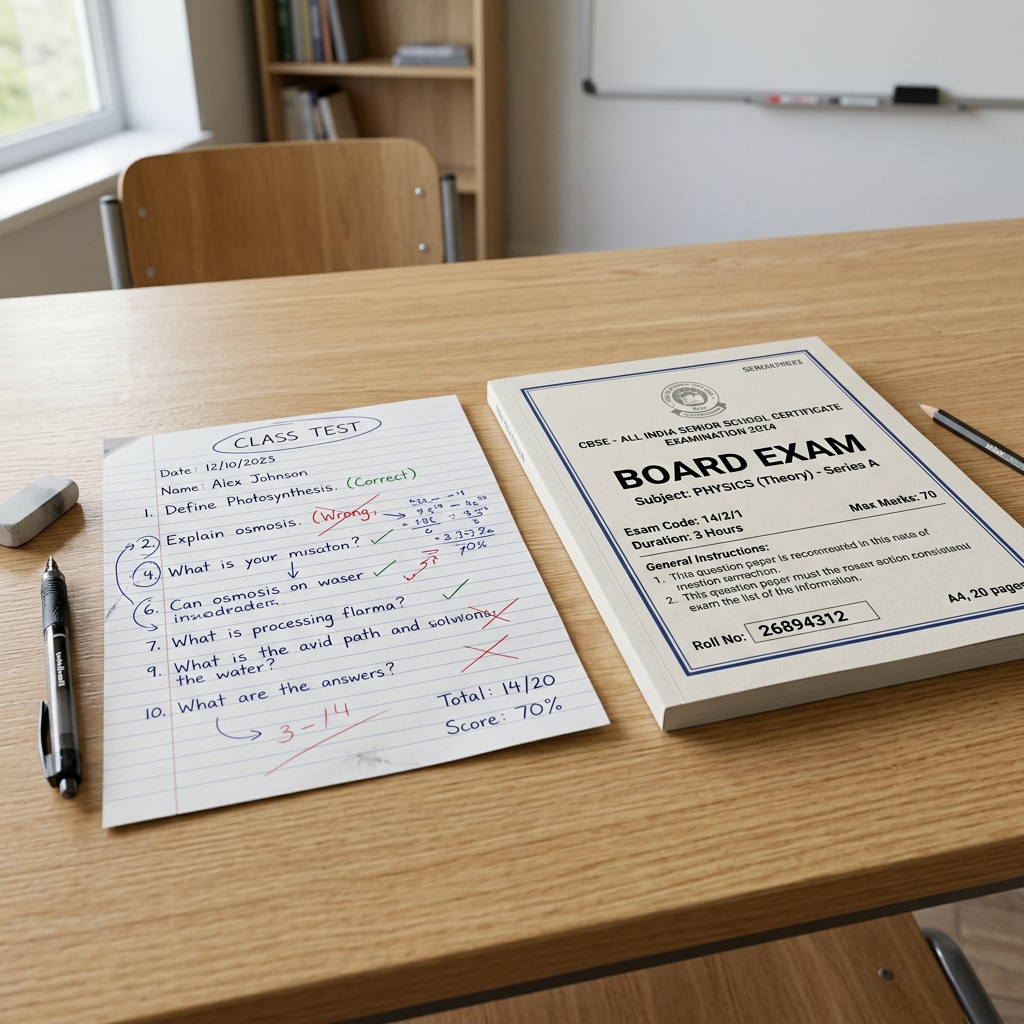
Every year, a common pattern repeats across secondary schools in Pakistan: students who consistently score 90% or above in their monthly school tests end up with average grades when the final board result is released. Conversely, some quiet students who hover around average marks in class tests suddenly secure top board positions. This mismatch happens because school tests and board exams are evaluated with completely different mindests, grading schemes, and syllabus scopes. To secure an A+ in Matric, you must understand these differences and adjust your study strategy accordingly. If you have started your preparation late, check out our guide on preparing for 9th class board exams starting late.
1. The Examiner's Psychology: Personal vs. Anonymous Grading
In school, your subject teacher knows you. They know your personality, your classroom participation, and your potential. When grading your class test, they read your answers with a personal bias. If your handwriting is messy or if you make a slight mistake in a definition, they might give you the benefit of the doubt because they know you understand the concept. They also have the luxury of time to read through your paragraphs.
A board examiner is an anonymous evaluator. They do not know your name, your school, or your academic history. They are sitting in a crowded evaluation hall, grading hundreds of papers a day. They are paid per paper, which means they spend an average of only 2 to 3 minutes reading your entire answer sheet. They use a strict, standardized "Marking Key" provided by the board. If your answer does not contain the key technical terms and headings listed in that key, they will mark it as wrong, regardless of how long or flowery your paragraphs are. This explains why subjects like math require special focus. Read our analysis on why students struggle with math in 9th class.
2. Paper Presentation: The Visual Hook
Because board examiners grade papers quickly, paper presentation is critical. A clean, visually organized paper immediately puts the examiner in a positive frame of mind. Follow these guidelines to make your paper stand out:
- The Margin Protocol: Draw double margins on the left and right sides of every sheet using a blue marker. This creates a clean frame for your answers and prevents writing close to the edges where pages might tear.
- Marker Headings (605 vs. 604): Use a thick 605 cut marker for main headings (e.g., SECTION-B, Q. No. 3) and a 604 marker for sub-headings (e.g., Definition, Examples, Diagram). Never write long questions without sub-headings.
- Equation Box: In Physics and Mathematics, whenever you derive a final equation or calculate a numerical answer, draw a box around it using a blue marker and write "Ans" clearly next to it.
- Pencil-Only Diagrams: Never draw diagrams with a pen. Use a sharp lead pencil to draw diagrams, and write labels in neat block letters. This allows you to correct mistakes without making your paper look messy.
3. Syllabus Scope: Deep Cramming vs. Spaced Revision
School tests are usually limited in scope, covering only 1 or 2 chapters at a time. This allows you to rely on short-term cramming (rote memorization) the night before the test. You can memorize every sentence, score full marks, and then forget the details a week later.
Board exams cover the entire textbook (often 8 to 16 chapters per subject). Rote memorization fails here because your brain cannot store that volume of detailed information in short-term memory. To succeed in board exams, you must transition to long-term memory techniques:
- Active Recall: Instead of reading your textbook repeatedly, close the book and write down everything you remember about a topic from memory. This active retrieval strengthens neural pathways.
- Spaced Repetition: Do not study a chapter once and leave it until the exams. Revise the same chapter at increasing intervals: 1 day after learning, then 1 week, then 3 weeks, and then 6 weeks. This moves the information from short-term to permanent memory.
4. The Marking Scheme Difference
Let's compare how a typical question is graded in school vs. the board exam:
| Grading Element | School Class Test | Board Examination |
|---|---|---|
| Definition Quality | General conceptual idea is accepted | Must match the exact textbook definition words |
| Handwriting & Margins | Ignored if content is readable | Directly impacts examiner patience (messy papers get lower marks) |
| Formulas & Units | Minor errors penalized slightly | Missing units (e.g., writing 5 instead of 5 m/s) results in automatic 1-mark deduction |
| Length of Answer | Longer paragraphs are preferred | Concise, bulleted answers with clear headings are preferred |
Conclusion: Adjusting Your Routine
To prepare effectively for the board exams, treat school tests as diagnostic tools rather than final targets. Use them to test your recall speed and presentation. After every school test, look at your paper and ask yourself: "If an external examiner who doesn't know me graded this paper, would they give me full marks?" This shift in perspective is what separates average students from board toppers.